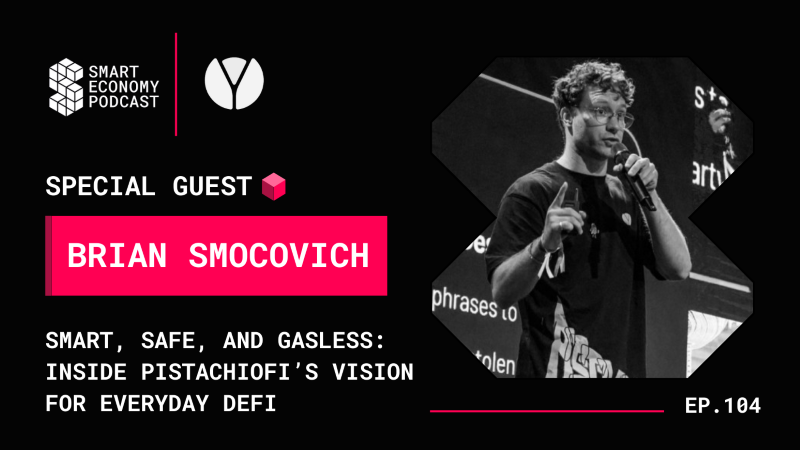
In this episode of The Smart Economy Podcast, host Dylan Grabowski is joined by Brian Smocovich, co-founder of PistachioFi, a blockchain finance mobile app designed to make DeFi more accessible. Together, they explore how Ethereum’s scaling journey has shaped product decisions, why L1 and L2 tradeoffs matter for consumer-facing apps, and how smart wallets may help reduce friction without sacrificing self-custody.
What you’ll learn:
- Why Ethereum’s rollup-centric roadmap introduced short-term complexity alongside long-term scaling benefits
- How liquidity fragmentation and gas costs influence real user behavior
- Why UX challenges like seed phrases, approvals, and gas remain barriers for non-technical users
- How PistachioFi approaches mobile-first, gasless wallet design
- Why cryptographic recovery can improve safety without custodial risk
- How L1 and L2 architecture decisions affect consumer financial products
- What gasless, cross-border transfers could mean for more accessible on-chain finance
- And much more!
Brian Smocovich is the co-founder of PistachioFi, a smart wallet focused on making on-chain finance safer and easier for everyday users. Prior to building in crypto, Brian worked in financial advising and management consulting, where he developed a deep understanding of risk management, financial infrastructure, and user trust. His background continues to shape PistachioFi’s focus on security-first design, intuitive UX, and practical pathways for broader on-chain participation.






About The Author: Arthur Bone
More posts by Arthur Bone